
Content SEO Checker: Complete Guide to Better, Search-Friendly Content

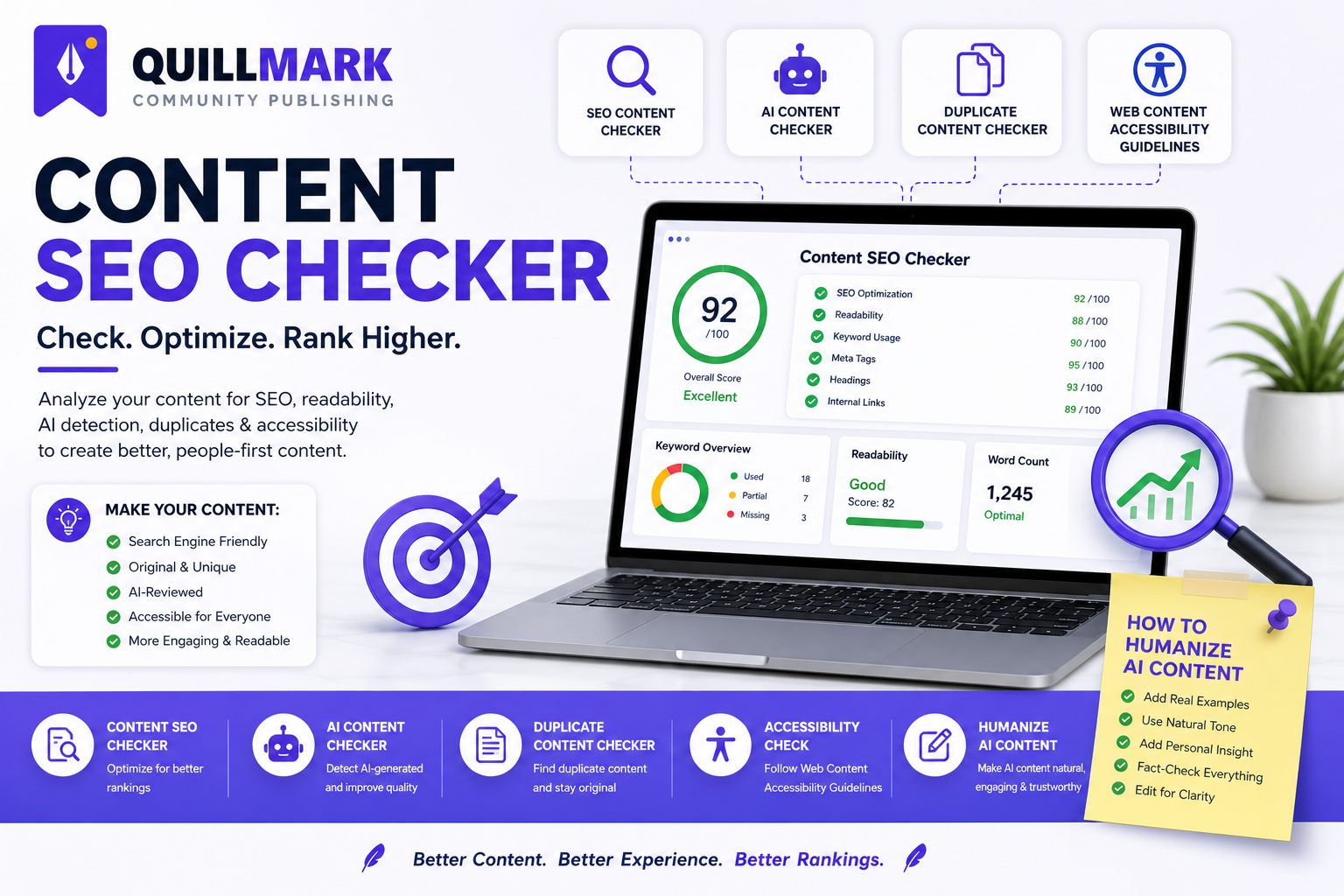
Creating content for search engines is no longer just about adding keywords to an article. Modern SEO requires content to be useful, readable, accessible, original, and aligned with what users are actually looking for.
This is where a content SEO checker can help.
Whether you’re publishing blog posts, product descriptions, landing pages, or large-scale website content, checking your content before publishing can help identify potential issues that may affect search visibility and user experience.
A good SEO content checker can analyze elements such as keyword usage, headings, readability, metadata, links, content structure, and other on-page SEO signals.
At the same time, tools such as an AI content checker and duplicate content checker can provide additional insights into originality and content quality.
What Is a Content SEO Checker?
A content SEO checker is a tool that analyzes written content against common search engine optimization and content-quality factors.
Depending on the tool, it may check:
- Keyword usage
- Keyword placement
- Headings
- Title and meta description
- Content length
- Readability
- Internal links
- External links
- Image alt text
- Content structure
- Duplicate content
- Basic technical SEO elements
- Accessibility considerations
The purpose isn’t to produce a perfect “SEO score.”
Instead, an effective checker should help you identify areas where content can be improved before it reaches your audience.
Why Use an SEO Content Checker?
Publishing an article without reviewing it can lead to simple mistakes.
For example, you might have a well-written article but forget to:
- Add a descriptive title
- Optimize the meta description
- Use logical headings
- Add internal links
- Include relevant keywords naturally
- Provide descriptive image alt text
- Check for duplicate sections
- Make the content easy to scan
An SEO content checker can bring these issues together in one analysis.
This is particularly useful when managing multiple websites or publishing content regularly.
What Does a Content Checker for SEO Analyze?
A content checker for SEO can evaluate several areas of a page.
1. Keyword Optimization
Keywords help search engines understand the subject of a page.
However, simply repeating the same keyword isn’t a good optimization strategy.
For example, if your primary keyword is:
content SEO checker
you don’t need to write:
Our content SEO checker is the best content SEO checker because our content SEO checker checks content SEO.
That creates an unnatural reading experience.
Instead, naturally cover related concepts such as:
- SEO content analysis
- Content optimization
- Search intent
- Keyword placement
- On-page SEO
- Content quality
This provides broader topical context without keyword stuffing.
2. Search Intent
A good content checker should encourage you to consider why someone is searching for a particular phrase.
For example, someone searching for:
“duplicate content checker”
may want a tool.
Someone searching:
“what is duplicate content?”
may want an explanation.
Someone searching:
“how to fix duplicate content”
is looking for a solution.
Your content should match the intent behind the query.
AI Content Checker: What Does It Do?
An AI content checker attempts to identify patterns that may indicate that text was generated or heavily assisted by artificial intelligence.
These tools may examine characteristics such as:
- Sentence patterns
- Predictability
- Repetition
- Vocabulary distribution
- Writing structure
- Stylistic patterns
However, AI detection is not a perfect science.
An AI checker can produce false positives or false negatives, meaning its result should not automatically be treated as proof that a person or AI wrote a piece of content.
Instead, use AI detection as one signal among several.
The more important question is whether the content is accurate, useful, original, well-written, and created to satisfy the reader’s needs.
AI Content Checker vs SEO Content Checker
These tools solve different problems.
| Tool | Main Purpose |
|---|---|
| Content SEO Checker | Identify SEO and content optimization opportunities |
| SEO Content Checker | Analyze content against SEO-related factors |
| AI Content Checker | Analyze patterns associated with AI-generated text |
| AI Checker | General AI-writing detection |
| Duplicate Content Checker | Identify potentially repeated or similar content |
They can complement each other.
For example, before publishing an article, you could:
Step 1: Run an SEO analysis.
Step 2: Review readability and structure.
Step 3: Check for duplicate sections.
Step 4: Review AI-generated sections critically.
Step 5: Add original insights and useful examples.
Step 6: Check accessibility and user experience.
Step 7: Publish and monitor performance.
Duplicate Content Checker: Why It Matters
A duplicate content checker helps identify text that appears elsewhere or repeated content within a website.
Duplicate or substantially similar content can occur for many legitimate reasons.
For example:
- Product variations
- Printer-friendly pages
- URL parameters
- Syndicated content
- Similar location pages
- Republished articles
- Multiple versions of the same page
Not every instance of duplicate content automatically results in a search-engine penalty.
However, unnecessary duplication can make it harder for search engines to understand which version of a page should be surfaced.
That is why checking content before publishing can be useful.
How to Use a Duplicate Content Checker
A basic workflow looks like this:
Step 1: Prepare your content
Copy the article, product description, or page text you want to analyze.
Step 2: Run the analysis
Enter the text into your duplicate content checker.
Step 3: Review matching sections
Look for phrases or paragraphs that appear elsewhere.
Step 4: Investigate the source
Determine whether the similarity is intentional or accidental.
Step 5: Improve originality
Where appropriate, rewrite the section using your own structure, examples, research, and insights.
Don’t rewrite content simply to make it “look different.”
The goal should be to make the content genuinely useful and original.
Web Content Accessibility Guidelines and SEO
SEO isn’t only about search engines.
Your content should also be accessible to people with different abilities and ways of browsing the web.
The Web Content Accessibility Guidelines (WCAG) provide internationally recognized recommendations for making web content more accessible.
Important considerations include:
- Meaningful headings
- Descriptive link text
- Text alternatives for informative images
- Sufficient color contrast
- Keyboard accessibility
- Clear page structure
- Form labels
- Captions or alternatives for relevant media
Accessibility and SEO aren’t identical disciplines, but they can overlap.
For example, descriptive headings improve content structure for users and can also make pages easier to understand and navigate.
Similarly, meaningful image alt text supports accessibility while helping search engines understand an image’s context.
How to Humanize AI Content
One of the most searched questions around AI writing is how to humanize AI content.
Humanizing content shouldn’t mean trying to trick an AI detector.
Instead, focus on improving the actual quality of the writing.
1. Add Original Experience
AI-generated text can sometimes sound generic.
Add information based on:
- Real projects
- Experiments
- Customer questions
- Product testing
- Industry observations
- Case studies
For example, instead of writing:
SEO tools can help improve your website.
You could explain exactly which SEO issue you discovered, what tool you used, what you changed, and what happened afterward—when you have genuine evidence.
2. Use a Natural Writing Style
Don’t make every sentence identical in length.
Good human writing naturally includes:
- Short sentences
- Longer explanations
- Questions
- Examples
- Transitions
- Personal observations when appropriate
The objective is clarity, not artificial imperfection.
3. Add Specific Examples
Generic:
Optimize your website for SEO.
Specific:
Review your title, H1, internal links, image alt text, and search intent before publishing the article.
Specific information makes content more useful.
4. Remove Repetition
AI-assisted drafts can sometimes repeat the same idea several times.
During editing, ask:
“Does this paragraph provide something new?”
If not, combine or remove it.
5. Fact-Check the Content
AI tools can generate inaccurate information.
Before publishing, verify:
- Statistics
- Dates
- Product specifications
- Quotes
- Research
- Company information
- Technical claims
Human review remains important.
Does AI Content Automatically Hurt SEO?
AI assistance and search quality are separate questions.
Using AI to help with brainstorming, outlining, editing, or drafting does not automatically determine whether content is useful.
The important consideration is whether the final content provides genuine value to users and meets applicable search-engine quality guidelines.
Instead of asking:
“How can I make AI content undetectable?”
a better question is:
“How can I make this content more accurate, original, useful, and relevant?”
That mindset leads to better content regardless of how the first draft was produced.
Content SEO Checker for Bloggers
Bloggers can use content analysis tools before publishing every article.
A practical checklist includes:
Content
- Does the article answer the main question?
- Does it satisfy search intent?
- Is the information accurate?
- Does it provide original value?
On-page SEO
- Is the title descriptive?
- Is there a clear H1?
- Are H2 and H3 headings logical?
- Are important terms used naturally?
- Are internal links relevant?
User experience
- Is the article easy to scan?
- Are paragraphs reasonably short?
- Are examples included?
- Are images useful?
- Is the page accessible?
Originality
- Is the content genuinely original?
- Have duplicated sections been reviewed?
- Are sources properly referenced where necessary?
Content SEO Checker for E-Commerce Websites
E-commerce websites have additional content challenges.
Product pages often contain manufacturer descriptions that appear across multiple stores.
Instead of copying the same description, businesses can create additional value through:
- Original product descriptions
- Product comparisons
- Buying guides
- FAQs
- Specifications
- Use cases
- Expert commentary
- Original photography
- Customer questions
A content SEO checker can help identify missing or weak page elements, while a duplicate content checker can help identify repeated descriptions.
How Content Checkers Fit Into an SEO Workflow
You don’t need to use a dozen tools for every article.
A simple workflow can be:
Keyword Research → Search Intent → Content Creation → SEO Check → Originality Review → Accessibility Review → Human Editing → Publish → Monitor
This workflow keeps tools in their proper role.
They should support your editorial process rather than replace it.
Can Content Checkers Guarantee Google Rankings?
No.
No content SEO checker can guarantee that an article will rank in Google.
Search visibility depends on many factors, including:
- Relevance
- Content quality
- Competition
- Search intent
- Website authority
- Technical SEO
- Links
- User experience
- Search engine systems
- Query-specific factors
A high tool score doesn’t automatically mean a page will rank.
Likewise, a page with a lower tool score can still perform well if it provides strong value for its target audience.
Use SEO tools as diagnostic assistants, not ranking guarantees.
Frequently Asked Questions
What is a content SEO checker?
A content SEO checker is a tool that analyzes written or webpage content for SEO-related factors such as keywords, headings, readability, links, metadata, and content structure.
What is an SEO content checker used for?
An SEO content checker helps identify potential optimization opportunities before content is published.
What is an AI content checker?
An AI content checker analyzes text for patterns that may be associated with AI-generated writing. Its results should be treated as estimates rather than definitive proof of authorship.
Is an AI checker 100% accurate?
No. AI detection tools can produce both false positives and false negatives, so their results should not be treated as conclusive.
What does a duplicate content checker do?
A duplicate content checker helps identify identical or substantially similar text across pages or other sources.
How can I humanize AI content?
Focus on accuracy, original insights, specific examples, natural editing, useful context, and fact-checking rather than simply trying to bypass AI detectors.
Are accessibility and SEO connected?
They are separate disciplines, but some practices overlap. Clear headings, descriptive links, meaningful image alternatives, and good page structure can benefit both accessibility and usability.
Should every article use an SEO content checker?
It isn’t mandatory, but checking important content before publishing can help identify issues that might otherwise be missed.
Final Thoughts
A modern content strategy needs more than keywords.
A content SEO checker, AI content checker, and duplicate content checker can each provide useful insights, but none should replace human judgment.
The strongest workflow combines technical SEO analysis with:
Search intent + Original information + Accessibility + Readability + Fact-checking + Human editing
If you’re using AI to accelerate content production, don’t focus only on passing an AI checker. Focus on making the final article genuinely helpful.
And if you’re wondering how to humanize AI content, the most reliable approach is simple: add real expertise, useful examples, accurate information, and a clear point of view supported by evidence.
That creates content that is valuable to readers first—and easier for search systems to understand as a result.

Manishvanshpal
Contributing writer and creator on the Quillmark community publishing platform.
Responses & Discussion (0)